When one of my characters does something--or wants to do something--that completely throws me off or brings my story to a screeching halt, I often write letters to my characters. These typically get posted on my private journal, because they sometimes have plot points that I don't wish to put all over the place. But they sometimes have lots of exclamation points and are full of CAPS to show my DISBELIEF or HORROR at what shenanigans my characters are getting up to. Or I'll argue with my characters in the form of a letter, or very occasionally apologize to them for horrible trauma that I have put them through.
There is something I find therapeutic about yelling at, wheedling with, or just talking to my characters in letters. Sometimes it even helps me solidify thoughts about them.
Anyway, I was contemplating what to do for this looming A-Z Blog Challenge and I decided--why not write letters to a character/person/idea/book/theme/whatever for each letter in my A-Z challenge? I sat down yesterday and wrote out letters to the letters A-G. And P.
On the writing/plotting side of things: have you ever written a letter to your character? If you have, did you find it fun/helpful?
Wednesday, March 30, 2011


Tuesday, March 29, 2011
Developing Characters, Part 6: Conflict
I've discussed five aspects of developing characters: motivation, perspective, personality, quirks, and speech. Today, I'm finishing up my series on developing characters by talking about conflict. I'm sure there are many other aspects to developing characters, and every writer will go about developing their characters in various ways. But when I think about how my characters develop, these six subjects are the primary building blocks for my characters.
Every character needs conflict. It can be outside conflict—something happening around the character that's causing the problem. It can be inward conflict—there's major turmoil going on within the character. They often go hand in hand. Inward conflict can be caused by the outward conflict. And sometimes outward is caused by the inward—the character is so troubled inwardly that he/she does something that causes huge problems outwardly. There are times when the characters are conflicted by each other and that opens a whole different can of worms.
A lot of times, you can give your character conflict by keeping them away from what they want. This goes back to the characters' motivations, when I talked about how all of them want something.
Maybe you have trouble making your character miserable or uncomfortable because you love him/her so much. Or on the opposite side of things, maybe you find it easy to rip apart their fictional lives. I, personally, don't have trouble throwing horrible things at my characters—because as hard and painful as it sometimes is to write these conflicts, I know what waits for them once they've come through it.
Do you have trouble with conflicts? What stumbling blocks are in the way of your characters? What stumbling blocks—external or internal—can you put in their way?
Friday, March 25, 2011
Developing Characters, Part 5: Speech
There are many types of "voice" in writing. The type of voice I'm talking about today is speech. How do your characters speak? Do they all sound like carbon copies of each other or do they all sound unique?
Even when I'm just starting out with a book and I'm still figuring out who the characters really are, I always hear them in my head. The way they would say something, the way they wouldn't say something. Everyone has a different voice. Different accents, different phrases, some very blunt, some very quiet. I have some characters who speak very formally due to background and upbringing. I have some characters who are more crass. The things that characters say can be as important as the way in which they say them.
As with characters' personalities, different things influence their speech: who they hang around, what they hear, what they read, what they do, what their personalities are.
Let's say I have some characters who all want to tell me they found my missing cat. They might all have very different ways of saying it. If I read someone talking, I might be able to figure out who is speaking just because of the way they say it.
Character 1: "I found your mangy old cat."
Character 2: "Hey, sweetheart, I think this is your cat."
Character 3: "I do believe I have found your animal."
Character 4: "Hello, Mrs. J. Were you aware that a domestic cat can run at speeds of thirty miles per hour? Your feline was very difficult to catch."
Character 5: "Is this yours? This stupid thing was hanging around in my barn! It scratched me! You're going to pay for this!"
Character 6: "Is this your kitty? She's so cute! Can I play with her? Can I come and visit her sometimes? Can I bring her a treat?"
The way a character talks says a lot about them. Do you "hear" your characters when you're writing them? Do they all sound different to you or are you unsure about how they speak?
One way that might help if you're having trouble finding a voice is to do what I did in the above example: pick a scenario and figure out how each of your characters would approach talking about the same subject. Writing their actions might help, too. Maybe one character is so shy that she just hands over the kitty and runs away without saying anything.
Do any of you have certain writing exercises that help you if you're having trouble with character voice?
Wednesday, March 23, 2011
A-Z Challenge
I kind of possibly just joined up with the A-Z Blog Challenge.

Eek! I'm trying to get the hang of blogging, and maybe this will help. Still: eek!
Eek! I'm trying to get the hang of blogging, and maybe this will help. Still: eek!
Tuesday, March 22, 2011
Win A Book
Because contests are fun and books are awesome. Check out Geek Girl's blog and contest here: 6 month blogoversary
Sunday, March 20, 2011
Developing Characters, Part 4: Quirks
We all have quirks--the little things about us that we do differently from other people. In today's blog, I'm going to be talking about physical quirks—the little things characters do that distinguish them from others.
This might not seem like a very important thing, but when I think of all of the elements that tend to make up my characters, this is actually a very big part of it. There have been a couple of times where I deliberately chose to make a character different in a physical way (like making a character left-handed), but what I'm talking about here are more the gestures or traits that characters might have. These are things that I don't plan—the characters show them to me as I begin to write them. These quirks distinguish one character from another in a very small way, perhaps, but it's a lot of small things that add up to making a character seem real. Some quirks might depend on occupations or backgrounds. For example, one character I have is a mechanic, and she has a tool in her pocket that she fiddles with when she's concentrating, upset, or scared.
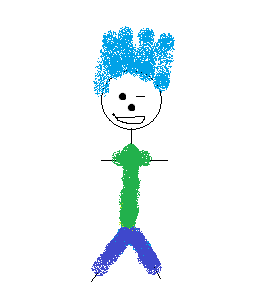
Here we have some handy stick figures to show some of the other things I'm talking about.
Character 1 rubs the back of his neck when he is uncomfortable or not sure what to say.

Character 2 winks. He just does. He's a flirt. I mean, with that hair, who wouldn't be attracted to him?
Character 3 rips any paper within grabbing range into little bitty pieces when she's anxious.

Character 4 likes knives. A lot. She's very good with them and maybe sometimes she spins them around in her fingers.

Some characters might be very well-trained in certain ways and might not have obvious quirks. I have another character who is a bounty hunter and so far, she has not shown me any noticeable quirk. I think that for her, she's had so much training and control over herself that that is her quirk—to keep still and keep every action deliberate. We'll see if this remains true as I write more about her, but this is what I'm guessing right now.
The only thing about character quirks is that you have to be really watchful of how many times the character does theirs. If you have a character shrugging their shoulders a hundred times in a book that's a hundred and fifty pages long, people might get quite annoyed with all that shrugging. As with most things, there is a balance.
What do you think? Do your characters have quirks? If so, what are they? When you're writing or reading, do you think that quirks distinguish one character from another or do you think it even matters?
This might not seem like a very important thing, but when I think of all of the elements that tend to make up my characters, this is actually a very big part of it. There have been a couple of times where I deliberately chose to make a character different in a physical way (like making a character left-handed), but what I'm talking about here are more the gestures or traits that characters might have. These are things that I don't plan—the characters show them to me as I begin to write them. These quirks distinguish one character from another in a very small way, perhaps, but it's a lot of small things that add up to making a character seem real. Some quirks might depend on occupations or backgrounds. For example, one character I have is a mechanic, and she has a tool in her pocket that she fiddles with when she's concentrating, upset, or scared.
Here we have some handy stick figures to show some of the other things I'm talking about.
Character 1 rubs the back of his neck when he is uncomfortable or not sure what to say.

Character 2 winks. He just does. He's a flirt. I mean, with that hair, who wouldn't be attracted to him?

Character 3 rips any paper within grabbing range into little bitty pieces when she's anxious.

Character 4 likes knives. A lot. She's very good with them and maybe sometimes she spins them around in her fingers.

Some characters might be very well-trained in certain ways and might not have obvious quirks. I have another character who is a bounty hunter and so far, she has not shown me any noticeable quirk. I think that for her, she's had so much training and control over herself that that is her quirk—to keep still and keep every action deliberate. We'll see if this remains true as I write more about her, but this is what I'm guessing right now.
The only thing about character quirks is that you have to be really watchful of how many times the character does theirs. If you have a character shrugging their shoulders a hundred times in a book that's a hundred and fifty pages long, people might get quite annoyed with all that shrugging. As with most things, there is a balance.
What do you think? Do your characters have quirks? If so, what are they? When you're writing or reading, do you think that quirks distinguish one character from another or do you think it even matters?
Thursday, March 17, 2011
Fun Stuff!
Becky Taylor, YA writer, is having a $50 Amazon gift card giveaway contest here: Becky Taylor Blog
Subscribe to:
Posts (Atom)