I've discussed five aspects of developing characters: motivation, perspective, personality, quirks, and speech. Today, I'm finishing up my series on developing characters by talking about conflict. I'm sure there are many other aspects to developing characters, and every writer will go about developing their characters in various ways. But when I think about how my characters develop, these six subjects are the primary building blocks for my characters.
Every character needs conflict. It can be outside conflict—something happening around the character that's causing the problem. It can be inward conflict—there's major turmoil going on within the character. They often go hand in hand. Inward conflict can be caused by the outward conflict. And sometimes outward is caused by the inward—the character is so troubled inwardly that he/she does something that causes huge problems outwardly. There are times when the characters are conflicted by each other and that opens a whole different can of worms.
A lot of times, you can give your character conflict by keeping them away from what they want. This goes back to the characters' motivations, when I talked about how all of them want something.
Maybe you have trouble making your character miserable or uncomfortable because you love him/her so much. Or on the opposite side of things, maybe you find it easy to rip apart their fictional lives. I, personally, don't have trouble throwing horrible things at my characters—because as hard and painful as it sometimes is to write these conflicts, I know what waits for them once they've come through it.
Do you have trouble with conflicts? What stumbling blocks are in the way of your characters? What stumbling blocks—external or internal—can you put in their way?
Showing posts with label developing characters. Show all posts
Showing posts with label developing characters. Show all posts
Tuesday, March 29, 2011


Friday, March 25, 2011
Developing Characters, Part 5: Speech
There are many types of "voice" in writing. The type of voice I'm talking about today is speech. How do your characters speak? Do they all sound like carbon copies of each other or do they all sound unique?
Even when I'm just starting out with a book and I'm still figuring out who the characters really are, I always hear them in my head. The way they would say something, the way they wouldn't say something. Everyone has a different voice. Different accents, different phrases, some very blunt, some very quiet. I have some characters who speak very formally due to background and upbringing. I have some characters who are more crass. The things that characters say can be as important as the way in which they say them.
As with characters' personalities, different things influence their speech: who they hang around, what they hear, what they read, what they do, what their personalities are.
Let's say I have some characters who all want to tell me they found my missing cat. They might all have very different ways of saying it. If I read someone talking, I might be able to figure out who is speaking just because of the way they say it.
Character 1: "I found your mangy old cat."
Character 2: "Hey, sweetheart, I think this is your cat."
Character 3: "I do believe I have found your animal."
Character 4: "Hello, Mrs. J. Were you aware that a domestic cat can run at speeds of thirty miles per hour? Your feline was very difficult to catch."
Character 5: "Is this yours? This stupid thing was hanging around in my barn! It scratched me! You're going to pay for this!"
Character 6: "Is this your kitty? She's so cute! Can I play with her? Can I come and visit her sometimes? Can I bring her a treat?"
The way a character talks says a lot about them. Do you "hear" your characters when you're writing them? Do they all sound different to you or are you unsure about how they speak?
One way that might help if you're having trouble finding a voice is to do what I did in the above example: pick a scenario and figure out how each of your characters would approach talking about the same subject. Writing their actions might help, too. Maybe one character is so shy that she just hands over the kitty and runs away without saying anything.
Do any of you have certain writing exercises that help you if you're having trouble with character voice?
Sunday, March 20, 2011
Developing Characters, Part 4: Quirks
We all have quirks--the little things about us that we do differently from other people. In today's blog, I'm going to be talking about physical quirks—the little things characters do that distinguish them from others.
This might not seem like a very important thing, but when I think of all of the elements that tend to make up my characters, this is actually a very big part of it. There have been a couple of times where I deliberately chose to make a character different in a physical way (like making a character left-handed), but what I'm talking about here are more the gestures or traits that characters might have. These are things that I don't plan—the characters show them to me as I begin to write them. These quirks distinguish one character from another in a very small way, perhaps, but it's a lot of small things that add up to making a character seem real. Some quirks might depend on occupations or backgrounds. For example, one character I have is a mechanic, and she has a tool in her pocket that she fiddles with when she's concentrating, upset, or scared.
Here we have some handy stick figures to show some of the other things I'm talking about.
Character 1 rubs the back of his neck when he is uncomfortable or not sure what to say.

Character 2 winks. He just does. He's a flirt. I mean, with that hair, who wouldn't be attracted to him?
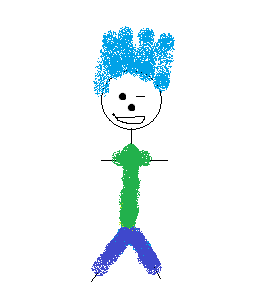
Character 3 rips any paper within grabbing range into little bitty pieces when she's anxious.

Character 4 likes knives. A lot. She's very good with them and maybe sometimes she spins them around in her fingers.

Some characters might be very well-trained in certain ways and might not have obvious quirks. I have another character who is a bounty hunter and so far, she has not shown me any noticeable quirk. I think that for her, she's had so much training and control over herself that that is her quirk—to keep still and keep every action deliberate. We'll see if this remains true as I write more about her, but this is what I'm guessing right now.
The only thing about character quirks is that you have to be really watchful of how many times the character does theirs. If you have a character shrugging their shoulders a hundred times in a book that's a hundred and fifty pages long, people might get quite annoyed with all that shrugging. As with most things, there is a balance.
What do you think? Do your characters have quirks? If so, what are they? When you're writing or reading, do you think that quirks distinguish one character from another or do you think it even matters?
This might not seem like a very important thing, but when I think of all of the elements that tend to make up my characters, this is actually a very big part of it. There have been a couple of times where I deliberately chose to make a character different in a physical way (like making a character left-handed), but what I'm talking about here are more the gestures or traits that characters might have. These are things that I don't plan—the characters show them to me as I begin to write them. These quirks distinguish one character from another in a very small way, perhaps, but it's a lot of small things that add up to making a character seem real. Some quirks might depend on occupations or backgrounds. For example, one character I have is a mechanic, and she has a tool in her pocket that she fiddles with when she's concentrating, upset, or scared.
Here we have some handy stick figures to show some of the other things I'm talking about.
Character 1 rubs the back of his neck when he is uncomfortable or not sure what to say.

Character 2 winks. He just does. He's a flirt. I mean, with that hair, who wouldn't be attracted to him?

Character 3 rips any paper within grabbing range into little bitty pieces when she's anxious.

Character 4 likes knives. A lot. She's very good with them and maybe sometimes she spins them around in her fingers.

Some characters might be very well-trained in certain ways and might not have obvious quirks. I have another character who is a bounty hunter and so far, she has not shown me any noticeable quirk. I think that for her, she's had so much training and control over herself that that is her quirk—to keep still and keep every action deliberate. We'll see if this remains true as I write more about her, but this is what I'm guessing right now.
The only thing about character quirks is that you have to be really watchful of how many times the character does theirs. If you have a character shrugging their shoulders a hundred times in a book that's a hundred and fifty pages long, people might get quite annoyed with all that shrugging. As with most things, there is a balance.
What do you think? Do your characters have quirks? If so, what are they? When you're writing or reading, do you think that quirks distinguish one character from another or do you think it even matters?
Thursday, March 17, 2011
Developing Characters, Part 3: Personality
"Watch your thoughts, for they become words.
Watch your words, for they become actions.
Watch your actions, for they become habits.
Watch your habits, for they become character.
Watch your character, for it becomes your destiny." ~ Unknown
It's a little difficult for me to approach the subject of character personalities. I typed all of this up and the more I tried to figure out how to define character personalities, the harder it seemed. So I will do my best to give my thoughts and if anyone has anything to add on how your characters' personalities develop, please feel free to share!
Every single person has a unique personality. Yes, there are personality types. Like when you take one of those questionnaire personality sheets and find out you're INTJ or whatever. (I cannot remember what any of those letters stands for except the I for Introvert. Introvert Nerd Tenacious Jolly? *goes to Google* Oh, here we go - Introverted Intuitive Thinking Judging.) (*still likes nerd* *IS a nerd*)
Anyway, there are of course basic personality types, but each person is still unique and so much can shape the way their personality develops. There are various influences on their lives—people, where they live, what someone says/does to them, happy childhood, miserable childhood, etc. I'm sure there a lot of other factors I didn't list. We could go all over the place with talking about how personalities develop, but it all boils down to one thing: each character is different even if they have similar personality types. Everyone has a different way of reacting. This can create great conflict for your story, or really interesting character interaction.
I've had a chance in the novel I'm currently writing to explore one specific point in three characters' lives. These three characters came from different families, have very different personalities, and they all went through one event that was absolutely horrific. One of these three characters had it worse than the other two, but when they came out of the awful event, all three of them had completely different ways of handling the situation.
--Character 1 ran away, blocked out most of the memories of the event, and spent years building up a million emotional walls to keep everyone out.
--Character 2 became determined to help anyone that needed it and sought to bring as much growth and beauty into life as possible.
--Character 3 shut down emotionally and became very ruthless.
There are so many things you can tell about a character by the way they interact with others, by the way they talk, by the choices they make. Your readers should be able to know by their personalities what is in character for them and what is not in character for them. This, too, can add to the impact of your stories. It can be an awesome thing if Character A does something that makes the readers gasp and go, "Wait, he wouldn't do that! That's not like him at all!"
At least, it can be an awesome thing if you have a logical reason behind this out-of-characterness. (Shh, characterness is a word. *writes it into dictionary*) Maybe someone Character A loves was kidnapped by pirates and he's desperate and he's in the middle of following instructions from the crazy pirate captain. Maybe another character will recognize that what he's doing is not like him at all, and will investigate the matter and find out that there was a kidnapping. Maybe that one bit of deliberate out-of-characterness will save the day.
It's not so awesome if there's no reason for your character to be acting weird and out of character.
And remember a cardinal rule of writing (which can be so hard to follow): have your characters do whenever possible, instead of narrating everything. Words and conversation are great (I love characters having conversations) but you can show a lot through actions and implications.
And remember a cardinal rule of writing (which can be so hard to follow): have your characters do whenever possible, instead of narrating everything. Words and conversation are great (I love characters having conversations) but you can show a lot through actions and implications.
When you sit down to write your characters, how do you find their personalities develop for you? Do you start writing knowing who they are, or do you find out along the way? Do you start writing thinking they'll have one personality and then come to find they're completely different than what you first imagined?
Friday, March 11, 2011
Developing Characters, Part 2: Perspective
Everyone has a point of view, and situations and characters will look completely different from alternate perspectives. It's something you have to keep in mind when you're writing a book, or when you are reading one. For example, I remember when Harry Potter and the Order of the Phoenix came out, some people were up in arms because Ginny "suddenly" had a personality. They thought it was out of character that she was acting differently around Harry, or talking to him. The thing is, though, that the Harry Potter series is told primarily through Harry's eyes, and for the first four years he knew Ginny, she acted like a girl with a dreadful crush around him. It was Harry's perspective we were seeing. Had we been seeing the whole series from someone else's point of view, chances are, Ginny would have been seen quite differently.
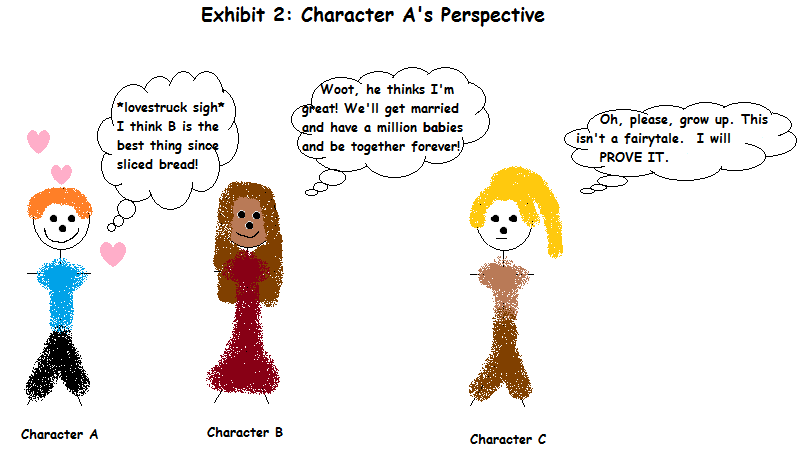
Let's go to Exhibits 1 through 4 for reference. The characters being blatantly mocked here may possibly be extreme exaggerations of some of my current characters. >_> (They're getting their comeuppance for everything they've put me through in writing them over the last year. They'll likely get revenge on me later for slandering their characters by doing something crazy. Well, crazier than usual.)
Here in Exhibit 1, we have what's really happening. If this story were being told from a completely objective narrative and we could see into all three characters' thoughts, it would look like this:

However, what if this story is told from Character A's point of view? Only he is going to know the truth of what he's thinking. Everything else is based completely on what he thinks is happening.
Same thing for Character B. Everything's a little more extreme from her point of view.

Character C's thoughts on the situation will be exaggerated because of her biases and her perceptions of the other characters.

Character perspective is very important. Whatever perspective you use is going to be the way the reader is introduced to the world. You might make people hate a character in one book, but when you switch viewpoints in another book, the readers see a different perspective and they come to love the character instead. Someone might seem mean and bristly to one character but loving to another. There is so much impact on the story and the world because of how one character sees everything.
How do you want your characters to be seen? What are you trying to say about them? What are you hoping readers come to understand from whatever point of view you use?
Let's go to Exhibits 1 through 4 for reference. The characters being blatantly mocked here may possibly be extreme exaggerations of some of my current characters. >_> (They're getting their comeuppance for everything they've put me through in writing them over the last year. They'll likely get revenge on me later for slandering their characters by doing something crazy. Well, crazier than usual.)
Here in Exhibit 1, we have what's really happening. If this story were being told from a completely objective narrative and we could see into all three characters' thoughts, it would look like this:

However, what if this story is told from Character A's point of view? Only he is going to know the truth of what he's thinking. Everything else is based completely on what he thinks is happening.

Same thing for Character B. Everything's a little more extreme from her point of view.

Character C's thoughts on the situation will be exaggerated because of her biases and her perceptions of the other characters.

Character perspective is very important. Whatever perspective you use is going to be the way the reader is introduced to the world. You might make people hate a character in one book, but when you switch viewpoints in another book, the readers see a different perspective and they come to love the character instead. Someone might seem mean and bristly to one character but loving to another. There is so much impact on the story and the world because of how one character sees everything.
How do you want your characters to be seen? What are you trying to say about them? What are you hoping readers come to understand from whatever point of view you use?
Thursday, March 10, 2011
Developing Characters, Part 1: Motivation
You know the part in Galaxy Quest when Jason is stuck on the planet with the rock monster? (If you do not know what I'm talking about because you have not seen Galaxy Quest--*gasp*--go watch it. Right now. Okay, or later. Sometime.) Anyway, Jason's on this planet, trying to figure out how to defeat the rock monster.
There's a line that Alexander gives him: "Well, you're just going to have to figure out what it wants. What is its motivation?"
That's the thing about characters. Every single one of them wants something in his/her life, for his/her life, for someone else in his/her life. Human beings are complex. Our emotions and thoughts and dreams are many. There are ulterior reasons for doing things. There are things we don't even realize until someone else points them out or we have an epiphany about why we're so motivated in one way or another. There are quiet dreams and loud dreams. And as many emotions and thoughts and dreams as there are, there are so many personalities to go with them.
I'd like to be able to say, "This is exactly how you write a well-rounded character!" but I can't. There's no clear-cut way to write--everyone is so very, very different in how they approach writing. Everyone has a style. Everyone has a way they work best. Music while writing, no music while writing. Absolute quiet is needed, or can work around a hundred people talking. And so on.
But every character is a person who exists on a page. Every character has something they want, and if you can find at least one thing, you can develop that character much better. It can be something that seems simple: a twelve-year-old who is desperate to fit into school. It can be something that seems more complicated: a college student whose dream is to travel the world, train dolphins, and start a charity--but first, they have to figure out how to get out of the cellar that their evil, identical cousin locked them in and stop him from switching human brains with monkey ones.
So what does your character want? And next, why do they want it? Why do they do what they do? Maybe they want to do something because of their parents or their friends, or because they saw a play in high school, or because becoming a mad genius who switches human and monkey brains sounded wizard, or because they watched an episode of Doctor Who and decided they wanted to find out if they could really grow a time machine.
Sometimes it takes a lot of digging and poking and prodding before I can figure out what my character really wants. Sometimes they dance around in crazy circles and scream at the top of their lungs about what they're going to do and why.
You have to find out what your characters' motivations are. I know some people write character interview questions and see how each character would answer the questions. Some people dive in and start writing to see what happens as it goes along.
Remember, motivations can change. Sometimes, it's crucial in a character journey that their motivations change. But then you will have new motivations, a new goal the character wants to work toward. It takes patience, and persistence, and sometimes some banging of the head against the keyboard when your characters announce entirely new plans halfway through your novel.
But that's half the fun. Er, not the banging-the-head-on-keyboard part, but having fresh goals and character growth.
Do you have certain ways you learn about your characters? Do you struggle with finding out what they want?
Stay tuned for the next post on characters, all about perspectives.
Subscribe to:
Posts (Atom)